Does Your Dog Have a Sense of Humor? Exploring Canine Playfulness

Updated: Dec 16, 2025
Understanding Canine Humor and Playfulness
By: Eileen Koval, CDBC, CBCC-KA, CPDT-KA, MSc
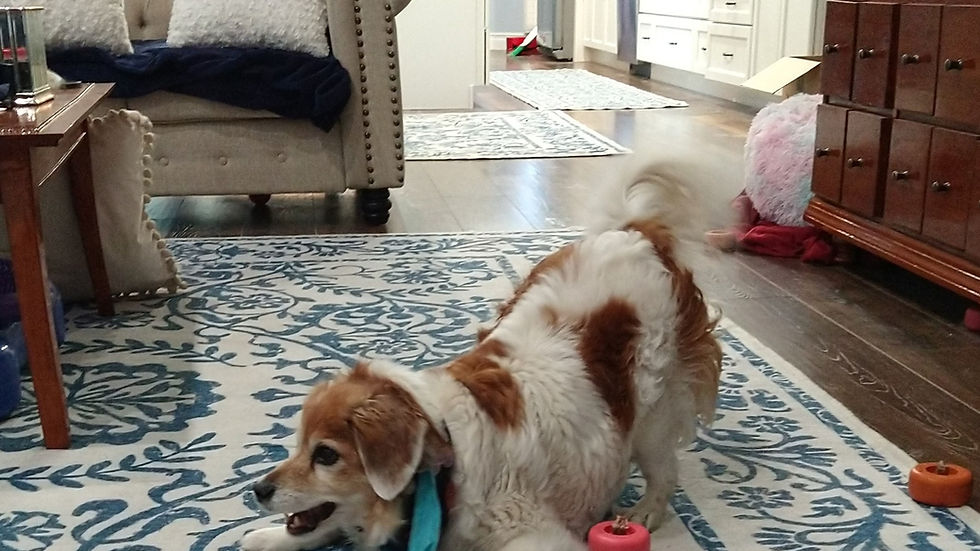
Does your dog play jokes on you, laugh, or have a sense of humor? Mine undoubtedly do. Two of my dogs have had very witty personalities, playing different jokes on me and my husband over the years. Dogs undoubtedly have distinct personalities, but they are often discounted for their abilities to experience deep emotions. Research by Jaak Panksepp and others shows that all mammals experience emotions like happiness, rage, jealousy, and even lust. We have more in common with our pets than we think!
Sometimes, pets can do things that are a bit annoying, but there is nothing tangibly beneficial for the animal when we examine the objective of the behavior. These may be practical jokes or a bit of teasing, similar to what we might do to a friend or sibling.
Personal Experiences with Playful Dogs
Recent examples come to mind that illustrate this playful behavior. This can drive me crazy at times—not too different from when my three brothers teased me growing up—but I cherish the comfortable relationship I have with my dogs.
Gilgamesh, one of my dogs, enjoys doing agility with me. After we finish running a sequence together, I often throw a squeaky tennis ball as a reward. He loves running into the nearest 15-foot tunnel to lie down and squeak the ball for a minute. Like many trained service dogs (he does diabetic alert/response), he knows the cues “pick it up” and “bring it to me.” However, he occasionally brings the ball close to the end of the tunnel. As I approach to pick it up, he darts over and places it further into the tunnel. If I ask him to retrieve it, he will pick it up and drop it in the same spot. He wants to watch me crawl into the tunnel!
When I crawl inside, he sometimes moves the ball even further away. He spins around in circles in excitement once I am far inside the tunnel. Interestingly, he does not play this joke on my husband or anyone else—only me! If I display any irritation in my voice, he will stop the teasing and bring me the ball. Like many people, he can tell when he has pushed things a bit too far. He knows when I am not in the right mood to enjoy his jokes. It does not matter if I have treats or not; that does not increase the frequency of him bringing the ball back to me in these situations. He simply wants to tease me and play a joke.
The Game of "Guess the Magic Word"
Another favorite game for him is "Guess the Magic Word." He plays this with both me and my husband, but more often with me. This can happen at the back door to the yard, anywhere in the backyard, and sometimes in the agility arena. He will suddenly freeze with his head lowered, similar to how he is in a stay at the agility start line, except that no one asked him to "stay."
We see that he has decided to freeze himself in a "stay" and give him his trained release word. He usually flinches but will not release. We have to go through a list of different words that he likes—come, free, tunnel, walk it, get it (the ball), run!, etc.—to see what the magic word is that day. When we give him the magic word, he takes off running, often engaging with the toy or the agility obstacle he wanted. He frequently spins around jubilantly.

Memories of Our Late Dog, Bones
Our late girl, Bones, used to play similar jokes. One joke she played in her old age was pretending to disobey certain cues and commands, only to follow them once she saw the shocked look on our faces. She was a little old lady when she started doing this—around 12-13 years old. She always had an automatic stay at all doorways since she was young, so she would wait at doors and gates until verbally released. This was for safety reasons, so she would not run into the street.
As she aged, there were a couple of instances where she stayed, and then my husband and I began to exit the doorway. She waited a few seconds and then darted out around us, spun in a circle a few times like “look at me!” and then ran back inside to her “stay” spot. She made a heavy, breathy sneezing sound several times as she did this. Many people consider this to be a dog's laughter sound. She only did that twice in her whole life. She thought it was hilarious, but we did not think so!
When she was around 8-9 years old, she started pretending to push boundaries. For example, she would pretend that she was going to engage with things that she was supposed to “leave” alone, like food on the coffee table or the trash can. She would act like she was going to do it but would not actually engage. Then, she would turn to look at my husband and me for our facial reaction. When she saw the shocked look on my face, she would spin around in a circle and make that breathy “laughter” exhalation. It seemed all about trying to achieve a particular response from us.
As a young dog, her favorite game (like many puppies) was “keep away” with toys, so we would chase her.
Clever Behaviors and Their Implications
There were also two instances in her history—once as a 2-year-old and again as a 6 to 7-year-old—when she peed on the floor and then pulled something over it to cover it up. We saw this on camera. These were not normal objects that she engaged with on the floor. One time, it was plastic sheeting from painting the walls. The other time, it was a washable pee pad, but she accidentally missed the pad while squatting.
The behavior served no function other than to likely hide the visible mess, although it seemed a bit more calculating than I would normally expect from dogs. She did not get in trouble for messes, but she knew we didn't like it. Those were not jokes, per se, but they demonstrated her clever nature.
We quickly learned upon moving to Las Vegas that she did not like going outside to potty during the summer. For her comfort, we laid out washable pee pads in the house to give her the option to pee inside during the hot months. She was a clever and feisty girl, so it was no surprise that she became sillier and more light-hearted in her older age. We often referred to her as our “cackling cutie.”

The Impact of Health on Canine Humor
Our late dog Beowulf did not exhibit as much humor as far as we could tell. However, he had several chronic painful conditions. As many people can likely relate, it is hard to be light-hearted and joking when we do not feel physically or mentally well.
Embracing Canine Humor
People might feel annoyed at their dogs’ teasing and jokes, but I view it from a different perspective. My dogs feel safe to be themselves around me. They feel secure enough to have a rich and complex relationship with us. I am not a drill sergeant; my dogs are not robots. If the focus is on controlling them, then people are getting pets for the wrong reason.
Owners lead and guide their pets, but I also consider us equals. A good leader knows when to let others take the lead and shine with their knowledge and talents. This perspective is shaped by my background in animal behavior and welfare, as well as my experience as a Kooikerhondje owner. The Kooikerhondje is a highly intelligent but sensitive breed that will not accept anything less than respect as an equal partner. They show zero respect and zero desire to work for an owner who does not treat them as a valued equal partner. Frankly, no dog should accept anything less!
Conclusion: What About You?
What jokes or humor does your dog display in their interactions with you? How do you respond to it?
----------------------------------------------
Interested in receiving notifications of educational information, new classes, and new articles/posts? Click here to go to our homepage and add your email to our subscriber's list!
----------------------------------------------

Eileen Koval, CDBC, CBCC-KA, CPDT-KA, MSc (in Operations Management) is a fully certified dog behavior consultant with the International Association of Animal Behavior Consultants (IAABC). She is currently working toward an M.S. in Applied Animal Behavior and Welfare at Husson University. Eileen believes that the foundation of a good cross-species relationship is understanding the needs and normal behavior patterns of each dog as an individual. She enjoys helping humans and dogs communicate more effectively to create brilliant relationships filled with joy, purpose, and fulfillment for all species involved. Eileen offers private consulting for serious dog behavior issues, obedience/manners, and agility training. She developed a unique online course to help pet parents and trainers develop reliable snake avoidance behavior off-leash through positive reinforcement techniques. These techniques have been applied by trainers worldwide to teach dogs reliable avoidance of dangerous environmental hazards and off-leash property boundaries. Eileen lives on a small ranch in Las Vegas, Nevada, with her husband and their Nederlandse Kooikerhondjes.


Comments